Getting shoe sizes wrong when importing from China is a costly mistake. Your inventory could be completely unsellable. Here’s how to ensure your US sizes are correct every time.
To convert Chinese shoe sizes1 to US, you need more than a chart. Chinese factories lack a universal standard, so sizes vary. You must confirm the exact measurement methods2 and size tolerances3 with your supplier before production to avoid receiving shoes that don't fit your customers.
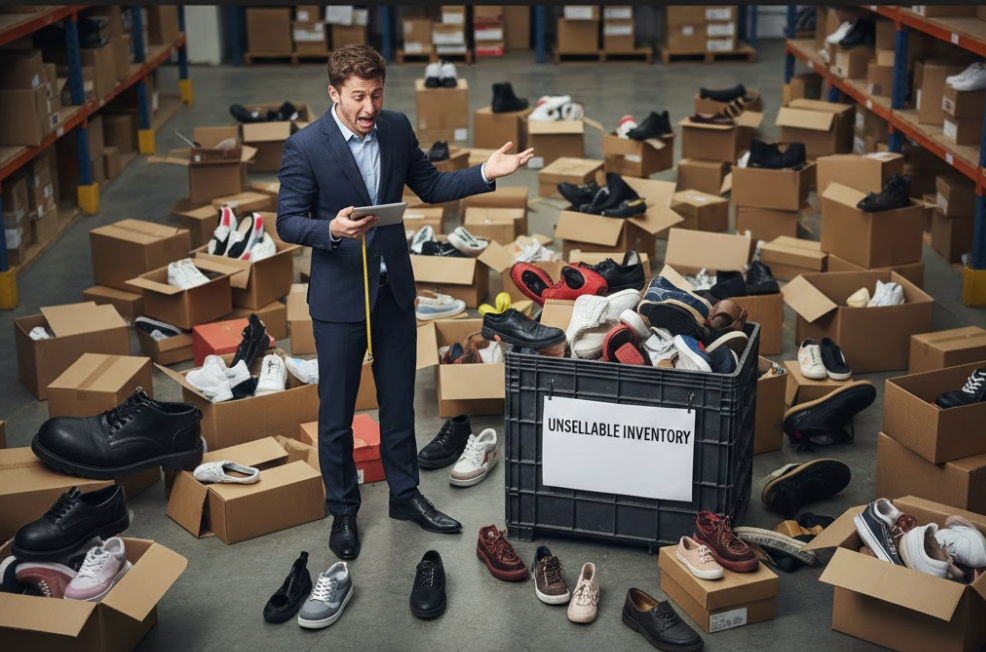
It seems simple, right? Just find a conversion chart4 and send it to the factory. But my years of experience sourcing products in China have taught me that it's never that straightforward, especially with shoes. The real problems aren't in the charts; they're hidden in the production process. Let's dive into what really matters.
How do Chinese and US shoe size standards actually differ?
Confused by the different shoe size numbers from your Chinese supplier? This isn't just about conversion; it's about two fundamentally different systems. Let's clarify this to prevent costly errors.
US shoe sizes5 are based on the barleycorn system, with numbers representing lengths in 1/3-inch increments. Chinese sizes often use millimeters, indicating the foot's length. This fundamental difference means there's no perfect conversion, and factories frequently use their own unique sizing standards, causing major inconsistencies.
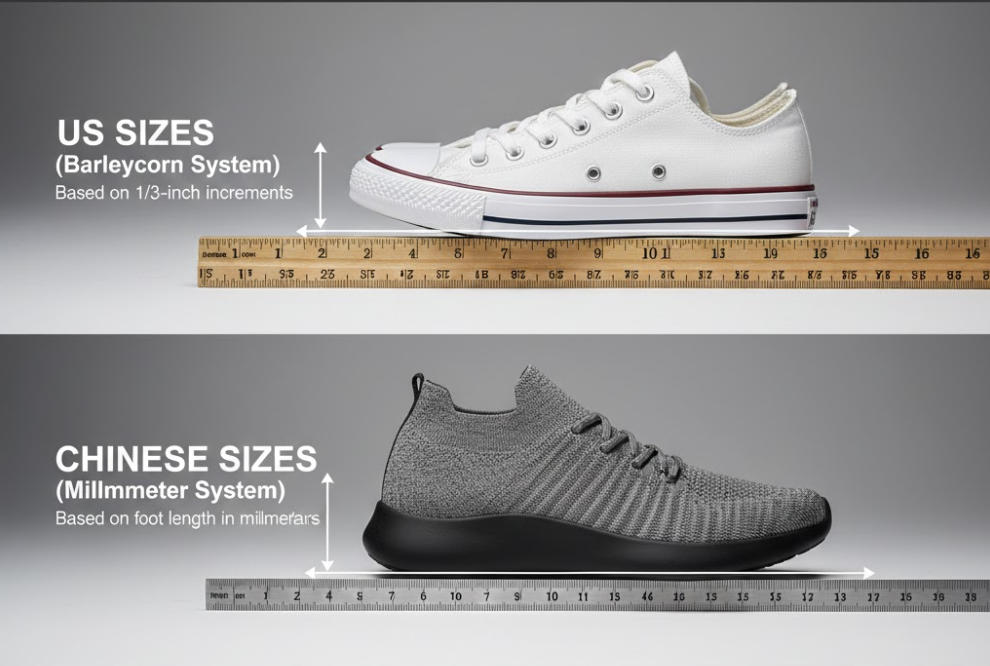
The core of the problem lies in the systems themselves. The US and UK use a system based on the "barleycorn," an old unit of measurement that's about 1/3 of an inch. A size 9 is not "9 inches long"; it's a number in a sequence where each full size increases by one barleycorn. To make it more confusing, the starting point for men's, women's, and children's sizes are all different.
In contrast, the Chinese system is often based on the metric system, which is far more logical. A size "270" is meant to fit a foot that is 270 millimeters long. This is similar to the Mondopoint system6 used for ski boots. Some factories, however, will use EU sizes7 (e.g., 42, 43), which are based on "Paris points" (2/3 of a centimeter). So when a supplier says "our size," you first need to clarify which system they're even talking about. There is no single, government-enforced standard that all shoe factories in China must follow, especially for export.
| System | Unit of Measurement | Example | What it Measures |
|---|---|---|---|
| US/UK | Barleycorn (1/3 inch) | Size 9 | An abstract length on a scale |
| Chinese (Metric) | Millimeters (mm) | Size 270 | The length of the foot |
| European (EU) | Paris Point (2/3 cm) | Size 42 | An abstract length on a scale |
This is why simply asking for a "US size 9" is a recipe for disaster. You and the factory are speaking different languages.
Where can you find a reliable Chinese shoe size to US conversion chart4?
You need a simple conversion chart4 for your shoe order. But every chart online seems to give a different answer. Here is a practical chart we use as a starting point.
Below is a generally accepted conversion chart4 for men's and women's shoes. Warning: This chart is for reference only. Its real value is as a starting point for your discussion. You must get your factory to confirm the exact insole measurements for every single size.
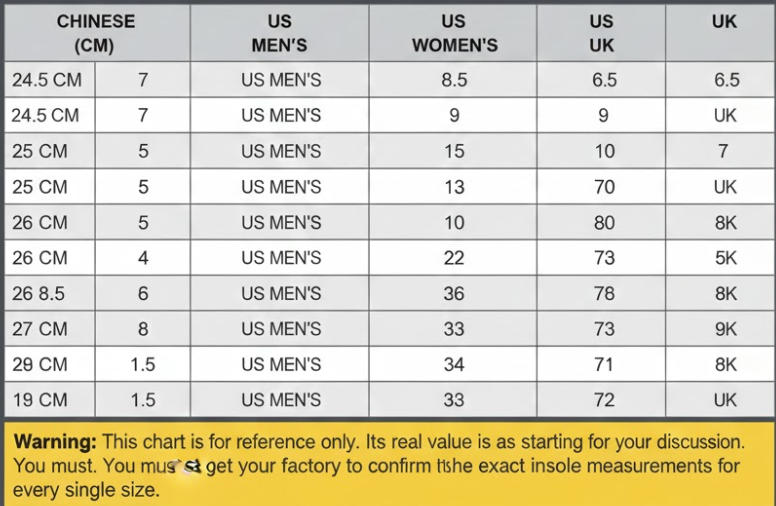
I've seen dozens of importers treat a conversion chart4 like a contract. They send it to the factory and assume the job is done. This is a huge mistake. A chart is a guide, not a rule. The only number that matters is the physical measurement you've agreed on.
Here are some common conversion tables we use as a starting point. Your only goal when using these is to translate your US size needs into a millimeter (mm) measurement.
| Women's Shoe Size Chart (Reference Only) | US Size | EU Size | China (mm) | Recommended Insole Length (mm) |
|---|---|---|---|---|
| 6 | 36-37 | 230 | 230-235 mm | |
| 7 | 37-38 | 240 | 240-245 mm | |
| 8 | 38-39 | 250 | 250-255 mm | |
| 9 | 39-40 | 260 | 260-265 mm |
| Men's Shoe Size Chart (Reference Only) | US Size | EU Size | China (mm) | Recommended Insole Length (mm) |
|---|---|---|---|---|
| 8 | 41 | 260 | 260-265 mm | |
| 9 | 42 | 270 | 270-275 mm | |
| 10 | 43 | 280 | 280-285 mm | |
| 11 | 44 | 290 | 290-295 mm |
I once had a client who approved an order based on a chart alone. The shoes arrived, and the entire batch was one size too small. The factory's "US 9" was 1cm shorter than the standard. The chart was useless because they never confirmed the physical measurement in millimeters. Use a chart to get your target millimeter number, and then make that number the specification.
Why are size charts from factories so inconsistent?
You finally get a size chart from your factory, but it doesn't match the last one. This inconsistency is frustrating and risky. Here’s the real reason it keeps happening.
Factory size charts are inconsistent because they are based on their specific shoe molds (lasts), not a universal standard. Each mold is different. A running shoe mold and a dress shoe mold for "size 9" will produce different fits. Factories also reuse old, unverified charts.
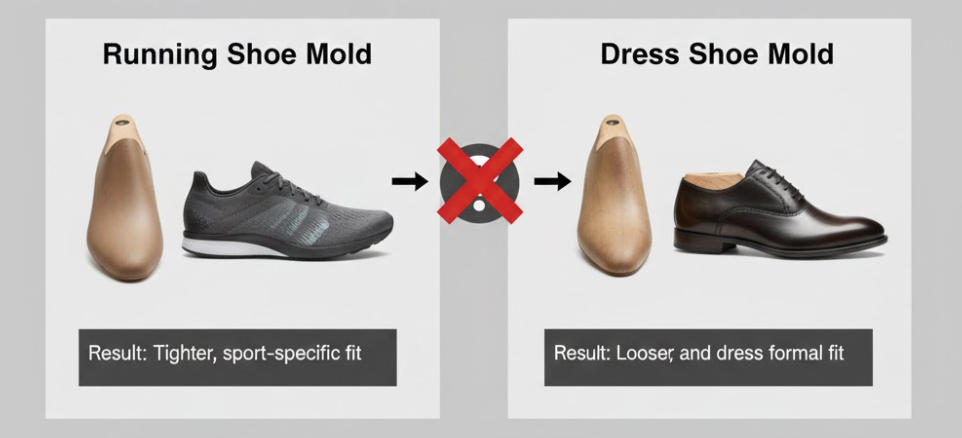
The "shoe last" is the foot-shaped mold that a shoe is built around. This last determines 100% of the shoe's internal dimensions and, therefore, its size and fit. A factory that specializes in bulky work boots will have completely different lasts than a factory making sleek dress shoes. Their "size 10" lasts are not interchangeable.
Factories invest a lot of money into their sets of lasts. They don't create new ones for every client. Instead, they use the lasts they have and try to match them to your request. The size chart they send you is just a reflection of the physical tools they own. This is why two different factories can give you two wildly different size charts for what seems like the same shoe.
Here's a common scenario:
| Factory A (Boots) | Factory B (Sneakers) | |
|---|---|---|
| Requested Size | US 10 | US 10 |
| Their Chart Says | 280 mm | 285 mm |
| Reason | Their boot last is naturally wider and shorter. | Their sneaker last is narrower and longer. |
Furthermore, many sales reps at factories are not technical experts. I've seen it happen many times: we ask for a size chart, and the salesperson just digs up an old file from a previous order with a Western client. They copy and paste it into an email without ever checking if it matches the lasts that will be used for your production. You cannot trust the chart. You can only trust a physical measurement.
What are the most common sizing mistakes8 buyers make in bulk orders?
You think you've covered all the bases on sizing for your bulk order. But many experienced importers still make simple, costly mistakes. Here are the most common traps to avoid.
The most common mistakes are approving orders based only on a chart, not physical measurements. Many buyers only check one sample size, forgetting to verify the entire size run. They also fail to define the measurement method (insole vs. outsole) and the acceptable size tolerance.
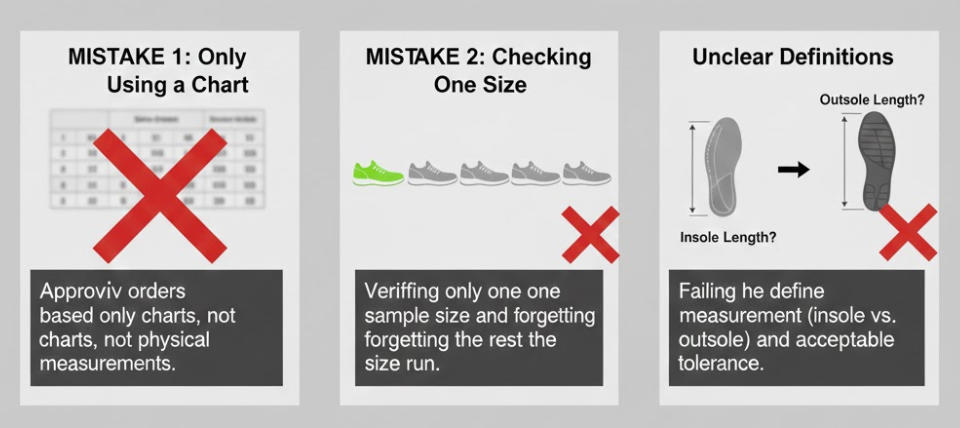
Over the years, I've seen the same sizing mistakes8 sink importers' projects again and again. They are almost always avoidable. Here are the top four culprits:
- Trusting the Chart Blindly: As we've discussed, this is the original sin of shoe importing. The chart is a conversation starter, not a specification.
- Approving Only One Sample Size: A client will get a perfect US size 9 sample. It fits great. They approve it and place an order for sizes 7 through 12. The order arrives, and the size 12s fit like 11s. Why? The factory nailed the size 9, but their "grading"—the mathematical rule they use to scale the size up and down—was wrong. You must verify the measurements for the smallest, middle, and largest sizes in your order to check the grading.
- Using Vague Measurement Terms: The buyer says "the shoe should be 28cm long." The factory agrees. The shoes arrive and are too small. The buyer measured the insole (inside), but the factory measured the outsole (bottom). The outsole is always longer. This ambiguity leads to unwinnable disputes.
- Forgetting Size Tolerance: You specify 280mm for a size 10. But manufacturing isn't perfect. Some shoes will be 278mm, some 282mm. If you don't define an acceptable range9 (e.g., ±3mm), the factory will use its own internal standard, which might be far too loose for your market.
I worked with a client importing boots. They approved the length but not the width. The boots arrived, and they were so narrow they were unwearable for the US market. A simple width measurement would have saved them $50,000.
How do sizes go wrong between sample approval10 and bulk production11?
The golden sample was perfect. You approved it, expecting thousands of identical shoes. But the bulk order arrived, and the fit is off. Let's look at why this nightmare happens.
Samples are often handmade by the factory's best technician, but bulk orders are mass-produced. This shift can cause size drift12. Different material batches, slight changes in machine settings, or even different workers on the line can alter the final dimensions of the shoe.
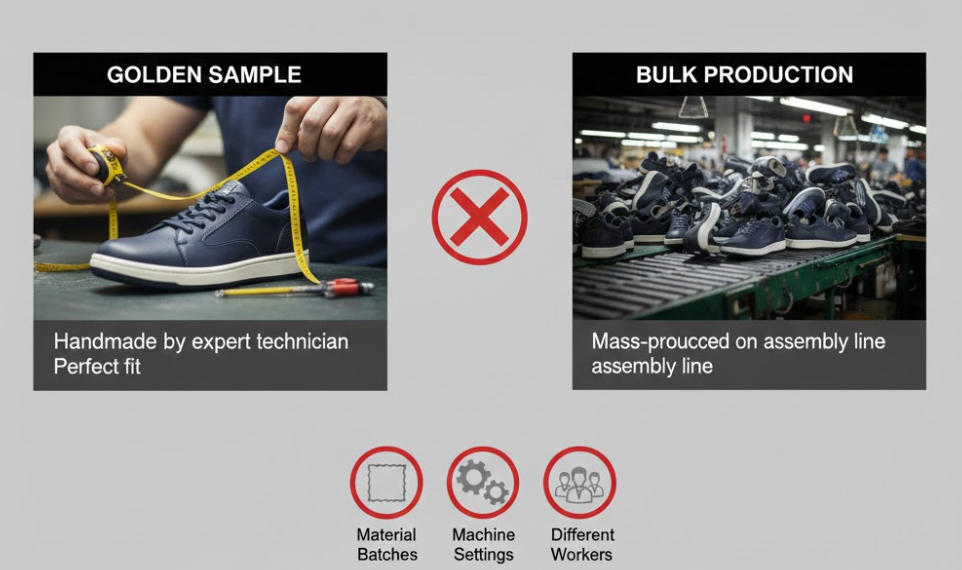
The "perfect sample" is one of the most dangerous traps in sourcing. You have to understand that a sample is a marketing tool. It's made in the factory's special sample room by their most skilled, senior technician. That person takes their time to make one perfect unit to win your business.
Bulk production is completely different. It's done on a fast-moving assembly line by dozens of different workers with varying skill levels, all trying to hit a daily quota. This shift alone can introduce small variations. But there are other factors:
- The "Master vs. The Line" Effect: The master technician who made your sample isn't making your 5,000-pair order. The line workers might stretch the material differently or glue it to the sole with a slight variance, changing the fit.
- Material Batch Variance: The leather or textile used for your sample came from one batch. The material for your bulk order might come from a different batch or even a different supplier. It could be slightly thicker, thinner, or have less stretch, all of which affects the final internal volume of the shoe.
- Process Creep: Sometimes, to speed up production, a manager might slightly change a process, like the time a shoe spends in a heating machine to set the glue. This can cause materials to shrink or expand differently than in the sample.
This is why a During-Production Inspection (DUPRO) is so critical. We go to the factory mid-production, pull shoes directly off the line, and measure them against your specification. This is how you catch deviations before they've ruined the whole order.
Which measurement methods2 cause the most disputes?
You agreed on the measurements, but the final product is wrong. The factory insists it's correct. This dispute isn't about numbers; it's about how you both are measuring.
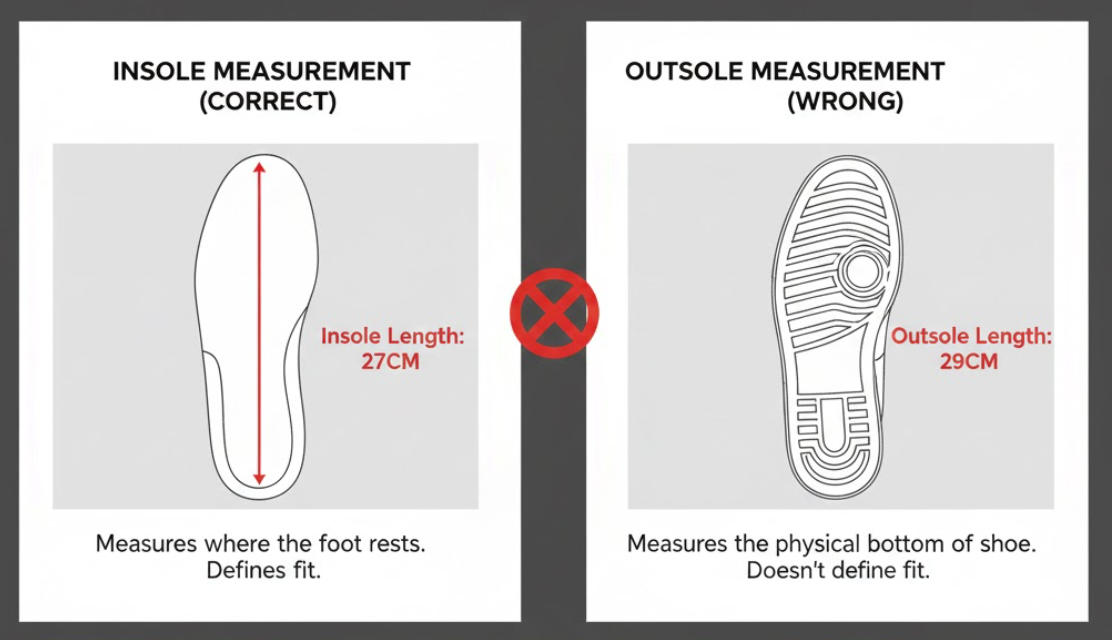
The biggest cause of disputes is measuring the outsole (bottom of the shoe) versus the insole (where the foot rests). You need the insole length, but factories may measure the outsole. You must clearly define your method, ideally with a picture showing the exact measurement points.
When a sizing dispute happens, it's rarely because someone is lying. It's because of ambiguity. Both you and the supplier believe you are "correct" because you are measuring differently. To win any dispute, you must remove all ambiguity from the start.
The number one point of conflict is Insole vs. Outsole.
- Insole Length: This is the measurement that matters for fit. It's the length of the inside of the shoe, where the foot actually goes. It can be measured by taking out the removable footbed or by using a special internal measuring device.
- Outsole Length: This is the length of the very bottom of the shoe. It's always longer than the insole because it includes the thickness of the shoe's walls and sole bumpers. Factories like to measure this because it's fast and easy—they just flip the shoe over.
If you approve a "length of 280mm" without specifying which length, you are leaving the door open for the factory to use the easier outsole method. When the shoes arrive and are too small, they will send you a photo of a ruler on the bottom of the shoe showing 280mm, and you will have no grounds to complain.
To prevent this, you must create a simple "Measurement Protocol." It should be a picture of the shoe with an arrow drawn on the insole, from the center of the heel to the center of the toe, with the text: "Insole length must be measured as shown." This leaves no room for interpretation.
How does size tolerance affect the final fit of a shoe?
You provided exact measurements, but the shoes in your bulk order still vary in size. The factory says this is normal. This is a problem of undefined size tolerance.
Size tolerance is the acceptable +/- variation in measurement. If you don't define it, the factory will use its own. A shoe that is 5mm shorter or longer than specified can be a full half-size off, creating an inconsistent fit and unhappy customers.
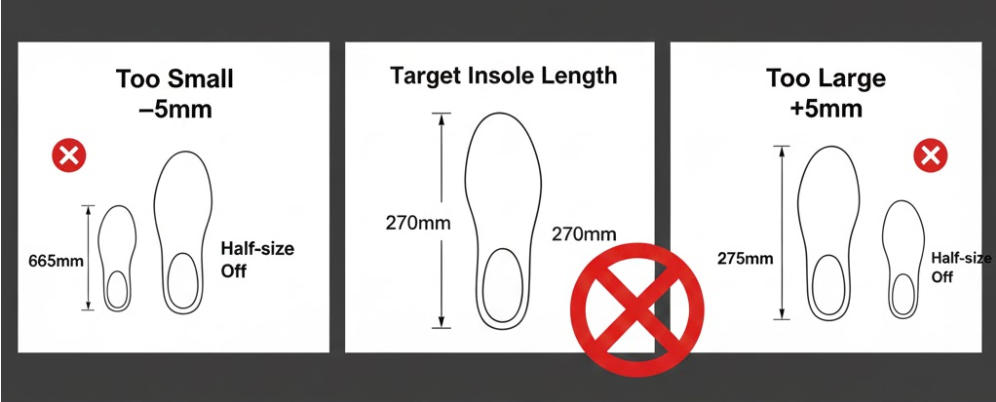
No manufacturing process is perfect. There will always be tiny variations in every product made. "Tolerance" is the mutually agreed-upon acceptable range9 of this variation. If you don't define this range, you are again at the mercy of the factory'
Understanding the differences can help you avoid costly mistakes when importing shoes. ↩
Understanding measurement methods can prevent disputes with suppliers. ↩
Knowing size tolerances can help you set acceptable variations for better fit. ↩
A reliable chart can serve as a starting point for accurate size conversions. ↩
Learn about the unique barleycorn system that defines US shoe sizes. ↩
This system offers a logical approach to shoe sizing that can simplify imports. ↩
Understanding EU sizes can help you communicate better with international suppliers. ↩
Avoiding these mistakes can save you from costly errors in your orders. ↩
Defining an acceptable range can help ensure customer satisfaction with fit. ↩
Sample approval is crucial for ensuring the final product meets your specifications. ↩
Understanding the differences between samples and bulk production can help you manage expectations. ↩
Understanding size drift can help you anticipate potential sizing issues. ↩